
Budget 2026 – Key Points
The Chancellor delivered his first Budget with targeted tax increases and changes to business reliefs.
Here are the main points and how they may affect you:
Income tax on savings and rental income
From 6th April 2027, the basic, higher and additional rates of income tax on savings income will increase to 24%, 44% and 49% respectively. The same rates will apply to property income in England, Wales and Northern Ireland, subject to the relevant devolved arrangements. These are two percentage points higher than the 22%, 42% and 47% rates announced in the 2025 Budget, and four points higher than the rates currently applying to ordinary savings income. The Personal Savings Allowance remains £1,000 for basic rate taxpayers and £500 for higher rate taxpayers.
The main income tax rates on earnings and pensions remain unchanged, as do the personal allowance of £12,570 and the basic rate band of £37,700. Their existing freeze until April 2031 continues; this is not a new extension announced in this Budget. Scottish income tax on non-savings income remains subject to separate decisions.
There are no further increases in dividend tax rates. The rates remain 10.75%, 35.75% and 39.35%, with the £500 dividend allowance unchanged. Corporation tax also remains at a main rate of 25%, with the 19% small profits rate and marginal relief continuing under the existing rules.
Business Asset Disposal Relief and Founders’ Relief
The lifetime limit for qualifying gains subject to Business Asset Disposal Relief (BADR) will be cut from £1 million to £500,000 for disposals from 6th April 2027. The BADR tax rate itself remains 18%. Where an owner makes a qualifying gain of £1 million, has not previously used the relief and pays 24% CGT on the £500,000 no longer qualifying, the change would increase the tax payable by £30,000. Previous BADR claims count towards the newly-reduced lifetime limit.
This could materially affect the proceeds from the sale of an owner-managed business. The rules include anti-forestalling provisions for transactions spanning the change date, so entering into a contract before April 2027 will not necessarily preserve the existing allowance.
A new Founders’ Relief is proposed from 6th April 2027, providing a 10% CGT rate on up to £10 million of lifetime gains on qualifying shares. However, the proposed qualifying conditions are demanding, with requirements involving shareholding and ownership periods, UK business presence and substantial growth or innovation.
The consultation currently envisages minimum business size tests, including turnover and employee numbers. The relief is consequently unlikely to benefit most small or microbusiness owners affected by the reduction in BADR. Its detailed rules remain subject to consultation and legislation.
Company distributions, share buybacks and restructuring
The Government intends to reform the taxation of company distributions and repayments of capital from April 2028, following further consultation and draft legislation. The proposals address capital reductions, share buybacks, demergers and other arrangements which can be used to extract accumulated profits at capital rather than income tax rates. They are intended to preserve appropriate treatment for genuine commercial exits and succession arrangements.
These changes may be important to owners planning a business sale, share buyback or family succession. The final rules have not yet been enacted, so the effect on particular transactions will need to be assessed once the legislation is available. Separately, proposed new reporting requirements for company payments to participators are not proceeding at present.
Capital allowances
The main pool writing-down allowance for plant and machinery will fall from 14% to 12% from 1st April 2027 for corporation tax and 6th April 2027 for income tax. At the same time, the main rate first-year allowance will increase from 40% to 50% for qualifying expenditure incurred from 1st January 2027. The first-year allowance is intended to apply to new qualifying main-rate equipment, including certain leased assets, but not second-hand assets or cars.
For many smaller businesses, the continuing £1 million Annual Investment Allowance will allow qualifying expenditure to be deducted in full, so the lower writing-down rate may have little immediate impact. It will matter where expenditure falls outside the up-front reliefs or remains in the main pool. Companies retain full expensing for eligible expenditure.
Trading and property allowances
The trading allowance and related Self-Assessment reporting threshold will rise from £1,000 to £3,000 from 6th April 2027. This can reduce the tax and administration burden for people with modest qualifying trading or miscellaneous receipts. The £3,000 figure relates to gross receipts, not profits, and taxpayers cannot claim both the allowance and actual expenses against the same income. The separate property income allowance remains unchanged at £1,000.
The National Living Wage and National Minimum Wage
These rates will increase from 1st April 2027. The new hourly rates, compared with those applying from April 2026, are:
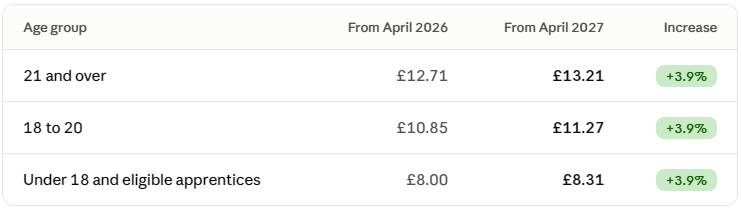
The headline increase is 3.9% across the principal age groups, but employers also need to allow for associated National Insurance and pension contribution costs and any knock-on effects on pay differentials. The general employer NIC rate remains 15% above the £5,000 secondary threshold, and Employment Allowance remains £10,500 for qualifying employers.
The Government also intends to reform employment contract non-compete clauses to make it easier for workers to move between employers and for growing businesses to recruit. Consultation and detailed proposals are expected before legislation is introduced.
The previously announced mandatory payrolling of benefits in kind will be introduced in stages. From 6th April 2027, company cars and vans, associated fuel benefits and medical benefits will be reported through payroll, together with the associated Income Tax and Class 1A National Insurance liabilities. Most other benefits will follow from April 2028, excluding employment-related loans and employer-provided living accommodation. The changes will require employers to prepare their payroll systems and review the timing of their National Insurance payments and associated cash-flow requirements.
Business mileage and motoring
The approved mileage rate for the first 10,000 business miles in a car or van will remain at £0.55 per mile, making permanent the temporary increase from £0.45 introduced in April 2026. For qualifying mileage above 10,000 miles, the rate rises from £0.25 to £0.35 from 6th April 2027. These rates also apply to simplified mileage deductions for self-employed taxpayers.
For someone travelling 15,000 qualifying business miles in 2027/28, the mileage calculation will be £7,250, compared with £6,750 at the current rates. There is no requirement for employers to reimburse employees at the new rates.
The temporary £0.05 fuel duty cut will continue until 30th June 2027, with the current plan being to reverse it and apply RPI uprating from 1st July 2027. The previously announced mileage-based Electric Vehicle Excise Duty is due to begin in April 2028 at £0.03 a mile for fully electric and hydrogen fuel-cell cars and £0.015 for plug-in hybrids. Company car benefit percentages will also rise for 2030/31, while public electric-vehicle charging is confirmed as subject to the standard 20% VAT rate from November 2026.
Business rates
From 1st April 2027, qualifying retail, hospitality and leisure premises in England will benefit from an increase in the rateable value threshold for full Small Business Rates Relief, from £12,000 to £18,000, with tapered relief extending to £21,000 rather than £15,000. This is a targeted change for those sectors, not a general increase in the thresholds for all small business premises.
Increases in qualifying bills will also be capped by CPI inflation in 2027/28 and 2028/29, subject to exceptions. Relief for qualifying pubs, social clubs and smaller live music venues will increase from 15% to 35%. Conversely, vape shops will lose certain business rates reliefs and multipliers, and adult gaming centres will lose retail, hospitality and leisure multipliers. The devolved administrations will determine their own approach to consequential funding. The existing £0.01 Transitional Relief Supplement will also be extended for two years from April 2027, helping to fund the business rates support.
Support for small-business finance
The British Business Bank’s Growth Guarantee Scheme is being expanded to support £6.5 billion of additional lending to small and medium-sized businesses over the Parliament. The Bank’s overall financial capacity will also increase by £5 billion, supporting wider access to finance for growing businesses.
Tax administration, reporting and payment
From April 2029, Self-Assessment taxpayers within payments on account are expected to move to more regular, automated payments during the year, with an option for some to pay through PAYE. The precise frequency and transitional safeguards have yet to be settled. This could significantly change the pattern of cash outflows for sole traders, landlords and company owners, even where their overall annual tax liability is unchanged.
Also from April 2029, businesses will generally be required to have a Direct Debit instruction in place for VAT and PAYE liabilities, subject to exceptions. Other methods will remain available until a specified cut-off, after which the Direct Debit arrangement can collect any outstanding amount. Separate proposals would allow more direct recovery of certain established tax debts from persistently non-engaging taxpayers.
Electronic invoicing and other changes
Mandatory electronic invoicing is planned from 1st April 2029 for VAT invoices, subject to exemptions still to be confirmed. Businesses will need to send and receive invoices as structured electronic data, rather than simply emailing PDFs. A separate consultation considers reporting invoice data to HMRC.
Making Tax Digital for Income Tax began in April 2026 for qualifying self-employed individuals and landlords with income exceeding £50,000. The previously announced rollout continues for those with qualifying income above £30,000 from April 2027 and above £20,000 from April 2028. For taxpayers required to join in April 2027, late-submission penalty points will not apply to quarterly updates for 2027/28, although the reporting obligations remain.
There are some other practical changes: late-filing penalties on UK property disposal returns will stop continuing to accrue once the gain has been reported through Self-Assessment, although the separate property reporting obligation remains.
From April 2028, removing the £2,500 threshold for employment expense claims will allow more employees to claim tax relief through PAYE without having to complete a Self-Assessment tax return solely for that purpose.
Proposed benchmark subsistence rates for qualifying business travel will rise from April 2028, including rates of £20, £60 and £75 for qualifying journeys exceeding five, ten and 24 hours respectively.
Pensions, inheritance tax and housing
A temporary Pension Tax Allowance will operate from 6th April 2027 to 5th April 2030, designed to prevent income tax being charged solely because the full new State Pension exceeds the personal allowance. It is a deduction from the tax otherwise payable, rather than a general increase in the personal allowance. The deduction is tapered for pensioners with income above the full new State Pension.
The previously announced inclusion of most unused pension funds and death benefits in estates for inheritance tax purposes will take effect from April 2027. This Budget includes related administrative provisions, but no new general change to agricultural or business property relief. Separately, the two-year rule which can make certain delayed pension death-benefit payments taxable is being removed for payments from 28th October 2026, subject to the remaining conditions.
The previously announced High Value Council Tax Surcharge (“Mansions Tax”) is due to start in England in April 2028 for residential properties worth at least £2 million. The Government has confirmed that there will be provision for deferment in qualifying circumstances, alongside discounts and exemptions, but detailed regulations are still needed.
For first-time buyers, a new First Time Buyer ISA will replace the Lifetime ISA for new savers from April 2029. It will allow annual contributions of up to £4,000 within the overall ISA limit, with a 25% Government bonus, subject to conditions and a £450,000 property price ceiling. Existing Lifetime ISA holders will be able to continue contributing to and using their accounts under the current rules. The existing £20,000 annual cash ISA subscription limit is being retained, reversing the earlier proposal to reduce it. From 29th October 2026, the LISA withdrawal charge falls from 25% to 20% for otherwise qualifying first-home purchases above the existing property price cap, rather than for all withdrawals.
The Government also proposes a new Your First Home equity-loan programme in England from April 2027, subject to eligibility and local price caps. A separate change will allow certain Child Benefit overpayments to be set against associated High Income Child Benefit Charge liabilities, with retrospective effect.
Household support and other measures
A £100 Household Energy Payment will be made through local authorities from January 2027 to households in council tax bands A to D in England, with further targeted support and separate arrangements for the devolved nations. Domestic electricity will benefit from a temporary VAT zero rate until 30th June 2027 in Great Britain, with different Northern Ireland arrangements. The Government also intends to abolish domestic gas standing charges in Great Britain by the end of 2027, or as soon as possible thereafter, although the associated costs will instead be reflected in unit rates.
A new parental allowance is proposed from April 2029 for eligible self-employed fathers, partners and adopters in Great Britain who do not qualify for statutory payments. Reforms to the Carer’s Allowance earnings rules are also planned. The adjustment to the State Pension triple lock from April 2030, announced at the Labour Party Conference in September 2026, has been confirmed in the Budget.
A Young Entrepreneurs Allowance will be piloted in England to help eligible young people meet living costs during their first year of self-employment. Further details of eligibility and how the pilot will operate have yet to be announced.
Overview
Overall, this Budget avoids increases in the principal tax rates on earned income and corporation profits but introduces changes with significant implications for particular groups. Business owners considering a sale may be especially affected by the lower BADR limit, while landlords and savers face higher tax rates and employers must budget for further wage increases. Longer-term changes to invoicing, payroll and tax collection will also require preparation, even where they do not increase the underlying tax liability.
If you have any worries or concerns about any of the announcements made in Budget 2026 please feel free to get in touch.
Studio Two
Presteigne Industrial Estate
Presteigne, Powys
LD8 2UF
Tel: 07786 293592
Email: elsa@elsajones.co.uk

Accounts. Self Assessment, Book Keeping, VAT